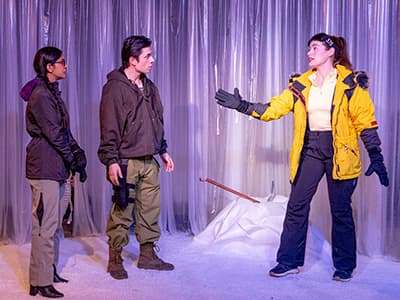

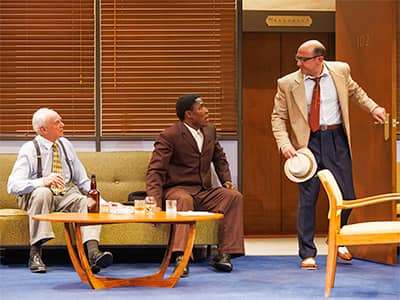
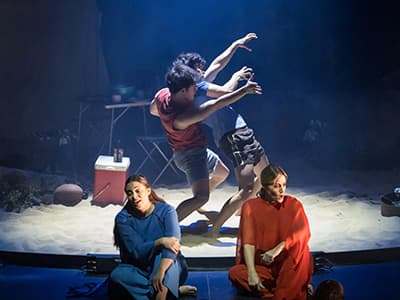
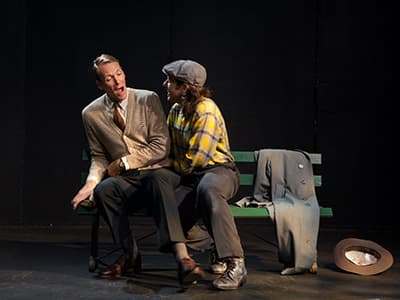
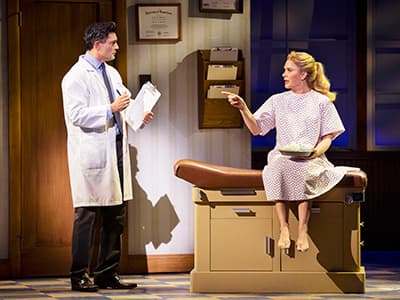

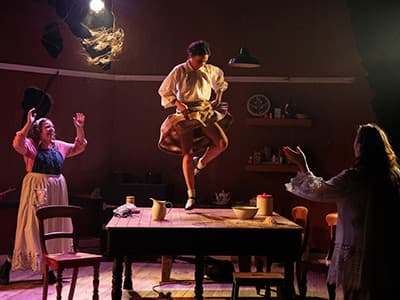
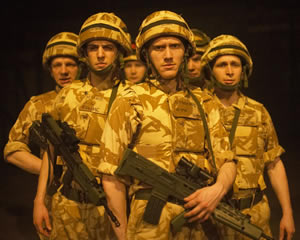
 Cast members from 2007 production. Photo - Manuel Harlan
Whether in play or movie form, war stories have similar flaws. For a start, it’s had to tell men in military uniform apart. The genre also suffers from over crowding. Stories of the futility of war are so common that its rare that one will throw up fresh insights. While Black Watch says nothing new about wars or those who fight in them, it entertains by incorporating many different theatrical forms.
A playwright enters a pub, hoping to get young Scotsmen to open up about their experiences in battle. What follows are anecdotes from these young men, the soldiers of the three hundred year old Black Watch Regiment, stationed in Iraq during the recent ongoing conflict.
These men were lured into the army expecting “Big fucking guns“ and “exotic poon tang”. Most of the actual fighting they do is over whether cheese on toast can be counted in a list of Indian food they would like to eat when they get home. The play is laced with humour including several witty observations on what is written or not written on certain pieces of paper carried by the men. Humour is essential when you have as much time to kill as these men do.
It is a delight to see such a large scale production in Australia. With a cast of ten well choreographed actors and a huge long stage, this is quite some spectacle. This highly physical performance demands a lot of its actors. There is much glistening sweat and rapid breathing as the actors take their bows. Fight scenes are choreographed ballet style while march pasts take on the preciseness of a military tattoo.
The main thing to like about this production is the use of stage and props. The audience is side on while the actors walk up and down catwalk style. The long narrow stage is perfect for conveying distance, as the soldiers stand watching bombs explode on the horizon. A pool table becomes an army vehicle or even a bunker. Director John Tiffany must have had some interesting games of pub snooker in his time.
The sound design is vital to creating the authenticity of Iraqi battle scenes. Like the soldiers themselves, you feel like going to ground immediately when planes fly over and bombs start dropping. As in any war zone, things get very loud. Video imagery is also used, as politicians make speeches attempting to justify why these young men are in Iraq.
With so many theatrical forms and elements of the story, the script becomes a grab bag. The playwright, Gregory Burke, putting a fictional version of himself in the play seems to have no purpose other than setting up a way to tell the story. More on the process of getting the men to open up would have been interesting. As it is we know too little about any of these characters. To be able to have a truly compelling piece of story telling, some elements of the story needed to be cut so others could be focused on in greater depth.
This is a play about boredom and thanks to so many difficult elements of movement and technical production it is anything but. Yet the play's greatest strength is also its biggest weakness. If you’re after a visual feast, be prepared for unique insights to be sacrificed.
National Theatre of Scotland
Black Watch
by Gregory Burke
Venue: CarriageWorks Bay 17 | 245 Wilson Street, Eveleigh
Dates/Times: January 10–26; Monday to Friday at 8.00pm, Saturday at 2.00pm & 8.00pm
Duration: 1hr 50mins, no interval
Price: $50 / $40
Bookings: Ticketmaster 1300 723 038
Online: www.sydneyfestival.org.au
There is a reason The Sapphires has become one of Australia's most beloved musicals.
3 June 2026
Canberra
2 June 2026
Sydney
30 May 2026
Sydney
Latest Reviews
Black Watch | National Theatre of Scotland
- Details